In this essay
Campfire Curiosities and My RootsWhy campfire conversations matter to meThe fire in my mindHow I will approach my articles and ideasSome of this is personal for meI am comfortable without a pathWhat I’ll be writing aboutJoin the conversationIf you’re just going to skim (which is cool with me), then here’s the key points:
- Campfire Curiosities is a place to think and discuss openly about all the many ideas and topics I find insatiably curious: AI, high strangeness, forgotten history, worldviews, and the questions that connect them.
- Entertaining a strange idea is not the same as believing it. There is much to learn and understand from all ideas and I work to entertain non-dualistic thinking in as many ways as I can.
- My own experiences have opened my aperture greatly, I’m excited to share but want to communicate a real epistemic humility that I’m far from understanding it all.
- You do not have to agree with me to join the conversation. Curiosity, open discussion, debate are welcome and I hope they improve all who get involved
- You’re going to hear some weird shit. Welcome to an epic attempt to unify AI at every angle, The Phenomenon, UFO/UAP, Consciousness, Religion, Worldviews, Philosophy, Science Fiction, Conspiracies and All the other ideas rattling around in my head.
If this sounds like the kind of place you want to be, then subscribe and let’s get to it
Campfire Curiosities and My Roots
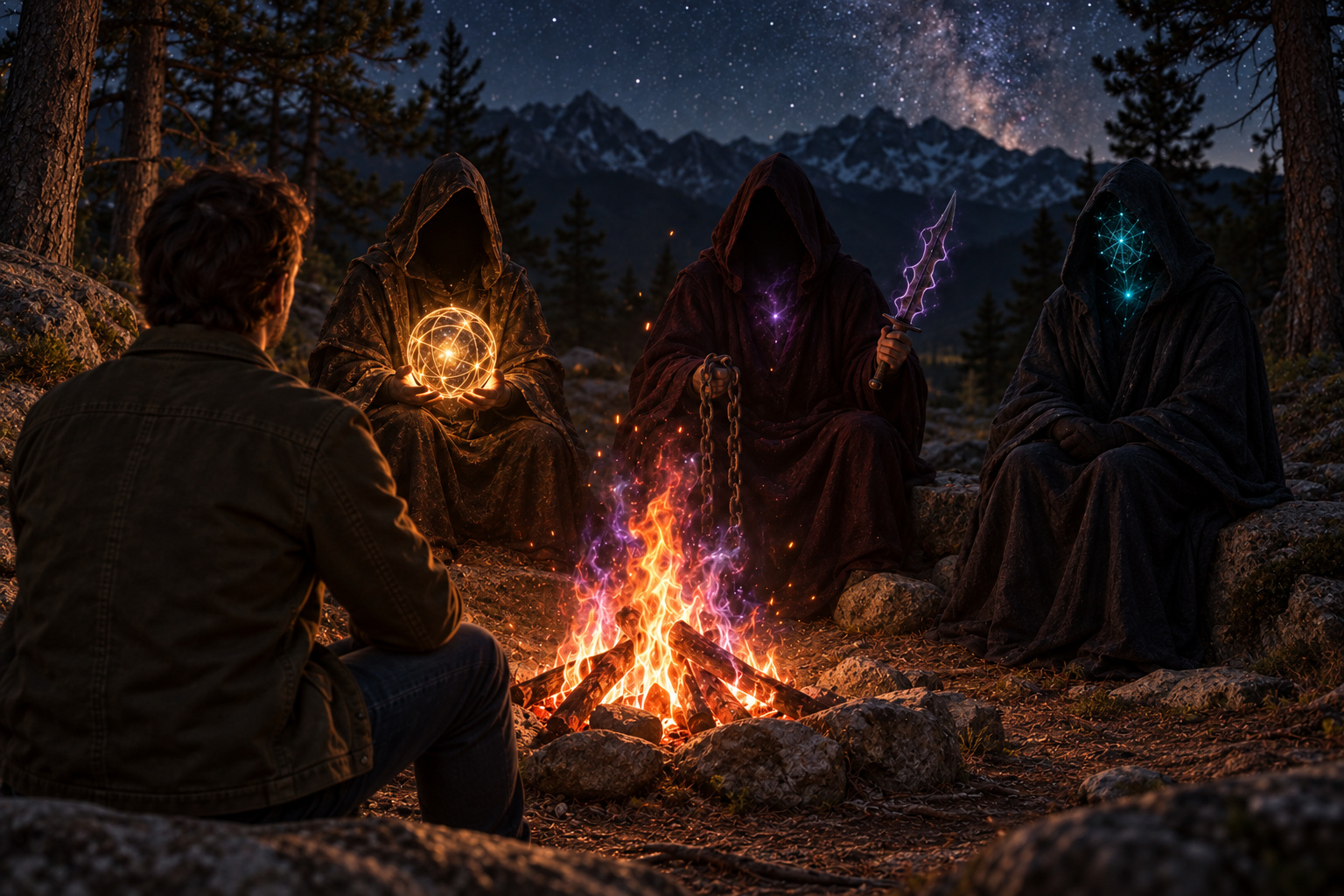
Some of my best conversations and deepest thinking have happened around campfires. That is the real reason for the name Campfire Curiosities.
Grown up in Colorado, being outside in nature and rivers fly fishing and mushroom hunting, I have a lot of time to think about a lot of different subjects. My insatiably need to know why and question absolutely everything has lead me to the path of Esotericism, High Strangeness and blend it in with my job and evolving career that is becoming more an more infested and elevated by AI. As I listen to dozens of podcasts a week, analyze and think about them, I’m left with a ton of great information and even larger questions. A trauma related event happened in my mid 30s, which lead me to have a “Plato’s Cave” like experience with my beliefs and paradigms and I’ve changed greatly over the years and am finally ready to share.
Why campfire conversations matter to me
I have noticed something consistent about good conversations around a fire: everyone is staring in the same direction. Nobody is making prolonged eye contact, nobody is performing for an audience, and somehow that seems to lower something in people. They become more honest, more vulnerable, more willing to say the thing they would normally keep back. More willing to listen, too.
A good campfire conversation does not require everyone to agree, and it does not always solve the problem that gets brought to it. Sometimes nobody solves the question that gets brought up. Everyone turns it over a few times before the conversation moves on. That is fine, the conversation still mattered.
That is the atmosphere I want Campfire Curiosities to recreate. It is not a lecture, a debate, or a newsletter that arrives with the confidence that it has figured something out. I want it to feel like a good conversation where interesting things are worth talking about even when the answers are not obvious.
The fire in my mind
I have always been a deep thinker and an intensely curious person, and my brain does not thrive by focusing on one subject forever. I like wearing different hats and moving between very different kinds of problems. I might spend part of a day thinking about AI architecture and then hear something about consciousness that sends me in a completely different direction that night. The pivot feels natural to me, even when it looks scattered from the outside.
So this publication will move across a lot of territory: AI, consciousness, UAP and UFO phenomena, anomalous and paranormal experiences, sleep paralysis, psychedelics, ancient history, archaeology, Gnosticism, religion, philosophy, spirituality, esotericism, nature, human behavior, business, interesting podcasts and conversations, and things that have happened to me personally. That list probably sounds like it was assembled by pulling random topics from a hat.
Curiosity connects every one of these topics, especially the question why.
Why does something happen? Why do people believe something? What are we missing? How does this work? Why does the same archetype or idea show up repeatedly across cultures and centuries? Why do people have experiences that do not fit our current understanding of reality? Why does a technology like AI suddenly change huge portions of human life in the span of a few years? I am especially drawn to mysteries and areas where I don’t think we have a complete explanation yet. Those are the places where the most interesting thinking tends to happen.
How I will approach my articles and ideas
Entertaining a strange idea is not the same as believing it.
There is much to learn and understand from all ideas and I work to entertain non-dualistic thinking in as many ways as I can.
Sometimes the most useful thing you can do is temporarily ask: suppose this were true. What follows? What else would need to be true? What evidence might we expect to find? Does the idea connect to anything else we know? Does it break apart under examination, or does something interesting emerge?
That exercise does not commit me to the idea. It just treats the idea as worth the time.
I think there is a difference between having an opinion and becoming attached to an opinion. I have ideas today that I think are probably wrong but still find worth exploring. There are things I once dismissed as ridiculous that I now take more seriously, and there are things I currently believe that I may change my mind about later. That seems like how thinking is supposed to work, and it does not bother me.
When I write what I think about UAP, consciousness, AI, religion, history, or anything else, I am explaining where I currently land based on what I know and have experienced so far. I am not asking the reader to agree. I genuinely welcome disagreement, and the ideal reader here is someone who can hear something they initially think is ridiculous and still listen long enough to understand why someone might think it. Seeking to understand should come before automatically judging.
Some of this is personal for me
Just like the spark that starts a fire, my traumatic experience was a catalyst for my evolution on my world-view. Many tertiary, but fairly un-related experiences both fused together and shattered my ideas on life. While it was hard, I came out better for it.
Some of my curiosity is not purely theoretical. I have had sleep paralysis experiences that left me genuinely uncertain about what had happened. I have had experiences I would probably have to call paranormal for lack of a better word. I have had psychedelic experiences that rearranged things. I have watched AI do things that changed how I think about intelligence and creativity in ways that still feel unresolved. I have spent years following unusual questions that led to other unusual questions.
I do not want to turn this first article into a deep explanation of any of those experiences. Each one deserves its own space, and I will get to them. For now I just want to establish that the curiosity driving this publication has personal roots.
Plato’s Cave has stayed with me because it asks a simple question: what if what we take for reality is only part of it? I am not saying I escaped the cave or know more than everyone else. The point for me is that an experience can change how you understand reality. Once that happens, it can be difficult to return to the certainty you had before. My experiences have not convinced me that I now know the truth. They have convinced me that reality may be larger and stranger than I previously assumed, and that I may have been working with less information than I thought.
I am comfortable without a path
I’m not lost, I just don’t have a path.
A lot of people want a path, a destination, or a clear worldview that organizes everything into a coherent shape. I understand the appeal. I am becoming more comfortable not having one. I can explore questions about religion, consciousness, reality, spirituality, science, and worldviews without needing a predetermined destination.
I am genuinely trying to understand things. I have also learned that I will probably never understand everything, and that investigation, thinking, and conversation still have value when they do not produce a final answer. For me, wandering means following a question because it is worth following, even when I do not know where it will lead.
What I’ll be writing about
Campfire Curiosities has four broad, overlapping areas:
- AI and the future it brings. I build with AI constantly and am genuinely fascinated by what it is becoming. This area will be practical and philosophical, often both at once. Expect things I am building and experimenting with, questions about AI applications in business and daily life, and harder questions about cognition, creativity, culture, family, and what it means for a technology to change what it means to think.
- High Strangeness and everything in between. This is where the UAP and UFO phenomena, alongside consciousness, sleep paralysis, experiencer accounts, psychic claims, paranormal experiences, esotericism, altered states, cryptids, and dozens of other topics can be discussed. I’ll explore a bunch of it, responses to what we learn and more.
- Amnesia. Graham Hancock has described humanity as a species with amnesia, and that phrase has stuck with me. The core question driving this area is: how much have we forgotten about ourselves? Ancient civilizations, archaeology, disputed timelines, strange discoveries, forgotten history, and the recurring question of whether the conventional story is as complete as we tend to assume. Alternative-history claims still have to earn their case. They are worth exploring because the conventional story may not contain every answer.
- Worldviews. Religion, philosophy, Gnosticism, spirituality, nature, culture, ethics, and meaning. The different frameworks humans have built to make sense of reality and decide how to live inside it. This area tends to run through everything else, which is probably the most honest way to understand it.
These four areas will bleed into each other. A question about consciousness might belong equally to High Strangeness and Worldviews. An AI development might turn into a question about what it means to be human, which is a question religion has been working on for millennia. The overlap usually holds the most interesting questions.
Join the conversation
If you made it this far, you have a reasonable sense of what this place is. It is somewhere to think out loud about things that do not have clean answers. A place to ask why without being required to reach a tidy conclusion, to entertain strange ideas without having to swear allegiance to them, and to disagree without ending the conversation.
If something here makes you want to respond, join the conversation. Subscribe and follow the journey as Campfire Curiosities develops. Disagree with me when you think I am wrong. Share your own experiences, and add ideas or connections I may have missed. The point is to keep the conversation honest, curious, and useful, even when we do not arrive at the same answer.
A note on AI: I use AI extensively as an assistant in creating Campfire Curiosities. The ideas, experiences and opinions are mine. AI and the agentic workflows I’ve built help me organize my thoughts, research gaps, improve readability, create media and prepare articles for publishing.
Join me on the journey, there’s always a seat for you at the campfire